Crime
Scene Guidelines for Human Remains
Detection Dog Handlers
or Forensic Evidence Dog Handlers
by
Adela Morris (CSST member)
 The purpose of a crime scene investigation is to establish if a crime
has been committed, what happened and to identify the person or person's
responsible. Most of this process is not the responsibility of the canine
handler.
The purpose of a crime scene investigation is to establish if a crime
has been committed, what happened and to identify the person or person's
responsible. Most of this process is not the responsibility of the canine
handler.
However,
a better understanding of the process will ensure that the canine handler
is a valuable resource. The last thing we want to do as handlers is
to compound the crime scene by adding something or by not properly protecting
it.
The role
that the canine handler will most likely fill is finding possible evidence
or the location of human remains.
|
|
CRIME
SCENE PRESERVATION
 Maintain
control of your dog
Maintain
control of your dog
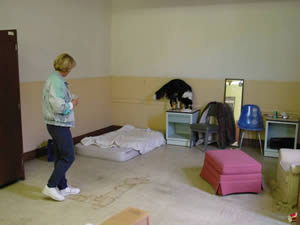
Continue to observe your dog, never taking your eyes off the dog. Use another
person to observe the scene, help with taking the notes for you, etc. Don't
move or change anything in the crime scene. When you are finished take your
dog to a safe location away from the crime scene.
The Correct
resource for the job
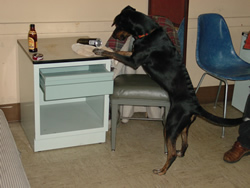
A dog chosen for a building search has been trained for the job. Only have the
best dog or dogs do the building searches. Should the dog locate potential evidence,
quietly take notes and mark the location.
Document
everything you do
Because you are working a crime scene chances are the case may go to court.
Document the facts.
BUILDING SEARCHING
 When
a house or a building has been established as a crime scene, there are several
things that the canine handler needs to know and do before entering. It is the
Canine Team Leader's responsibility to advise the teams of any information that
has been given by the requesting agency. The teams should be advised of any
areas that are off limits or not covered in the search warrant, what they can
and cannot touch, and what they are looking for. Evidence can be inadmissible
to the case (even if it's a dead body) if you search an area that is not covered
in the search warrant.
When
a house or a building has been established as a crime scene, there are several
things that the canine handler needs to know and do before entering. It is the
Canine Team Leader's responsibility to advise the teams of any information that
has been given by the requesting agency. The teams should be advised of any
areas that are off limits or not covered in the search warrant, what they can
and cannot touch, and what they are looking for. Evidence can be inadmissible
to the case (even if it's a dead body) if you search an area that is not covered
in the search warrant.
The team leader
needs to choose carefully those teams that will search the buildings. Usually
only two teams will search a building. This is not the time to see how a new
dog works in a house or a building. Chosen dogs should have the ability to search
calmly and not interfere with other ongoing activities. It is inappropriate
to have a dog search a house or a building that will dig, retrieve items or
damage things.
Many times there
are house pets like cats, rats and rabbits that the dog will have to ignore.
Dogs should be given ample time to urinate and defecate before entering the
house. We must remember this is someone's home. The person may not like animals
and may be innocent.
Teams are chosen
for the handler's experience, understanding how scent travels and pools in buildings,
cold wall syndrome, heating and air conditioning scent problems. Only a few
teams will be selected for building searches and it should be clearly understood
that this is not the time to train or have your ego hurt because you were not
chosen for this search.
 The
canine teams should expect that the person documenting the entrance of all people
entering the building would ask them their name and agency. Most of the time
they will have the dog teams enter the building first. This means that evidence
has not been established and you should consider everything as evidence.
The
canine teams should expect that the person documenting the entrance of all people
entering the building would ask them their name and agency. Most of the time
they will have the dog teams enter the building first. This means that evidence
has not been established and you should consider everything as evidence.
Each dog working
the building should be observed by the same person from the canine team, documenting
what the team did in the building. The notes this person takes should be part
of the group report that the agency may request. Gloves should be worn by the
handler and all off limit areas should be clearly understood. A good way to
do that is for the person documenting the teams to keep the team in the proper
areas - that way the canine handler can concentrate on the dog.
All teams entering
the crime or the potential crime scene must be willing to provide samples of
their hair, blood, shoe prints, fingerprints etc. for evidence elimination purposes
if requested.
One of the first things done by one of the technicians at the crime scene is
to videotape and photograph everything. This is done before any evidence is
collected.
One of the techniques
used by law enforcement agencies is to document the crime scene using a video
camera. Once the video camera begins recording it usually will continue to run
until the search is finished. This means we want to keep the canine teams out
of the way of the camera not to obstruct the view. And remember sounds are also
being recorded.
This also holds true in taking still pictures.
VEHICLE
SEARCHING
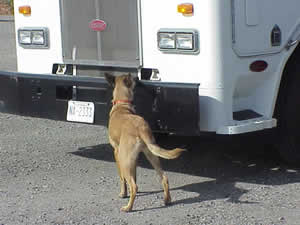 Vehicles are very difficult to search. Dogs are looking for residual scent,
small amounts of blood or body fluid. Teams chosen for these searches need to
have the same qualities described for house / building searching. Keep in mind
that in house and vehicle searching, we are looking for small amounts of scent
and most of the time the alert or interest from your dog will be subtle.
Vehicles are very difficult to search. Dogs are looking for residual scent,
small amounts of blood or body fluid. Teams chosen for these searches need to
have the same qualities described for house / building searching. Keep in mind
that in house and vehicle searching, we are looking for small amounts of scent
and most of the time the alert or interest from your dog will be subtle.
There are different
schools of thought in vehicle searching. The important thing is to work with
the agency in charge and have them decide what is the best method for them and
the case they are working on.
They may want a single vehicle search or a blind vehicle line up.
One technique for vehicle line-ups can be done in the following manner. Prior
arrangements with the law enforcement agency need to have been made so more
than one vehicle can be available to search. Anywhere from 2 to 4 negative vehicles
will be needed. The team or teams are not given any information on the type
of vehicle or how many suspect vehicles there are. License plates should all
be covered if obvious law enforcement plates are present on any vehicles. The
team leader needs to find out if the technicians have gone through the suspected
vehicle to look for evidence and fingerprints. It is always a good idea for
the handler to wear latex gloves as to prevent adding their own fingerprints.
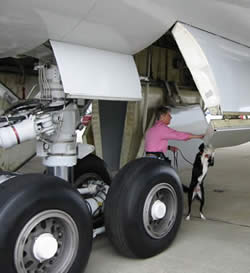 The
team leader will have to decide with the agency what will be best, working one
team or working two teams, both have pros and cons. But the best and most experienced
team(s) should be chosen to do the vehicle search. If it is decided to work
two teams, they should not observe each other working the vehicles.
The
team leader will have to decide with the agency what will be best, working one
team or working two teams, both have pros and cons. But the best and most experienced
team(s) should be chosen to do the vehicle search. If it is decided to work
two teams, they should not observe each other working the vehicles.
Each team will have their dog search the vehicle blindly from the other canine
team but observed by the team leader. Some team leaders prefer not to know which
vehicle(s) is the suspect vehicle. This way they observe the dogs working without
prejudice. When the team has finished they leave the vehicle line up and call
in the next team. As with all forensic searching, the team must not discuss
what their dog did with teams that have not yet worked. If it is agreed within
the group, the teams that have already worked can observe the other teams working.
After all teams have searched, the team leader may want teams to re-search a
vehicle or area of a vehicle depending on what they have observed.
An explanation of the different types of things the dog could be alerting on
is important for the agency to understand. Remember that by telling the agency
a dog showed interest in a vehicle they might decide to put thousands of dollars
and man hours into searching it.
Most dogs will
alert on semen, so it is important to know if the dog that has worked the vehicle
has been trained on it as a negative and to let the law enforcement agency know.